Series: The Sequentia Lectures: Unlocking the Math of AI
Part 7: The Frontier – Open Problems & Research Directions
Lecture 62: Geometric Deep Learning: Generalizing Neural Networks with Symmetries and Group Theory
Throughout this series, we’ve encountered different neural network architectures designed for different types of data.
- For simple tabular data, we use Multi-Layer Perceptrons (MLPs).
- For images, which have a grid structure, we use Convolutional Neural Networks (CNNs).
- For sequences like text, which have an ordered structure, we use Recurrent Neural Networks (RNNs) or Transformers.
But why do we need all these different architectures? Is there a deeper, unifying mathematical principle that connects them all? The answer may lie in a cutting-edge and exciting field called Geometric Deep Learning.
The Core Idea: Building in the Symmetries of Data
Geometric Deep Learning proposes that the best neural network architecture for a given task is one that is designed to respect the symmetries and structure inherent to the data’s domain.
What is a “symmetry”? In this context, it’s a transformation you can apply to the data that doesn’t change its fundamental meaning or identity.
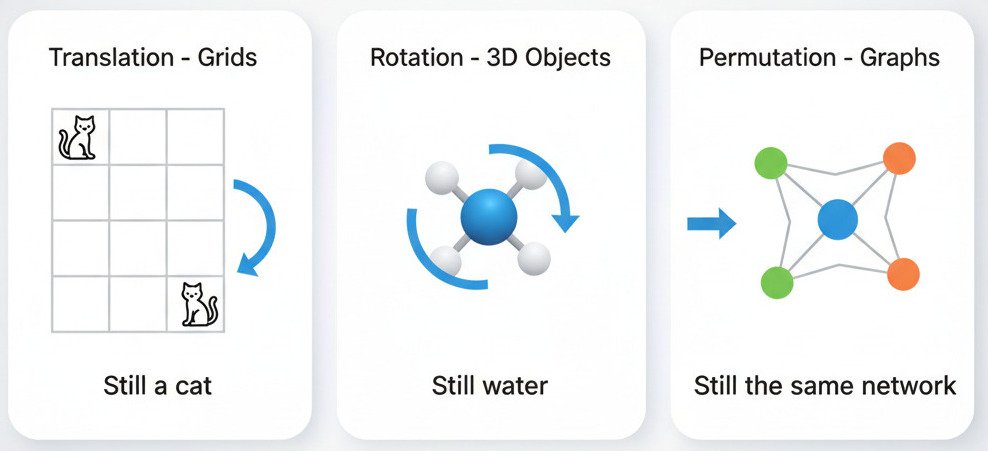
- Images & Translation: The most famous example is an image. If you have a picture of a cat, and you shift the cat two pixels to the right, it’s still a picture of a cat. The meaning is invariant to translation. A CNN, with its sliding filters, is an architecture that inherently respects this translational symmetry. A filter looks for a feature regardless of its position.
- 3D Molecules & Rotation: Imagine you have data representing a 3D molecule. If you rotate that molecule in space, it’s still the exact same molecule with the same chemical properties. The data’s meaning is invariant to rotation. A standard CNN would struggle here, as a rotated molecule would look like a completely new set of pixels. A Geometric Deep Learning model would be built with operations that are “equivariant” to rotation, meaning the model’s output rotates in the same way the input does.
- Social Networks & Permutation: Consider a social network represented as a graph. The way you order the nodes (the people) in your data file is arbitrary. You can shuffle, or permute, the order, and it’s still the exact same network structure. The meaning is invariant to permutation. Graph Neural Networks (GNNs) are a form of Geometric Deep Learning designed to respect this permutation symmetry.
The Blueprint of Geometric Deep Learning
This field provides a “blueprint” for designing neural networks based on the geometry of the data. It leverages advanced mathematical concepts from fields like group theory (the mathematics of symmetry), graph theory, and differential geometry.
The general idea is to replace the standard operations of deep learning with new ones that are custom-built for the data’s structure. Instead of a simple convolution on a grid, you might have a “graph convolution” that operates on a social network, or a “spherical convolution” that operates on data from a 360-degree camera.
By building these symmetries directly into the architecture of the model, we gain several huge advantages:
- Data Efficiency: The model doesn’t have to waste time and data learning these fundamental symmetries from scratch. If you tell a model that rotation doesn’t matter for a molecule, it doesn’t need to be shown thousands of examples of the same molecule in every possible orientation. It can learn much faster from less data.
- Better Generalization: Because the model is built on the true underlying structure of the problem, it’s much more likely to learn robust, generalizable patterns rather than spurious correlations.
- A Unifying Theory: Geometric Deep Learning provides a beautiful, unified mathematical framework. It shows that MLPs, CNNs, and even Transformers are not just a collection of separate tricks, but are all specific instances of the same general principle, each tailored to the symmetries of its respective data type (unstructured data, grids, and sequences).
The Frontier of Foundational Models
Geometric Deep Learning is at the forefront of AI research. It’s driving breakthroughs in areas where data doesn’t fit into neat grids or sequences:
- Drug Discovery & Chemistry: Modeling molecular interactions.
- Physics Simulations: Simulating complex physical systems.
- Computer Graphics: Working with 3D meshes and point clouds.
- Recommendation Systems: Modeling the complex graph of users and items.
It represents a shift from “let the data speak for itself” to a more principled approach: “let’s build a model that understands the fundamental language and rules of the data’s world before it even begins to learn.” It’s a quest to find the perfect architectural prior for every type of data, a journey deep into the mathematical heart of structure and symmetry.
