Series: The Sequentia Lectures: Unlocking the Math of AI
Part 1: The Foundation – Thinking Like a Machine
Lecture 5: Supervised vs. Unsupervised Learning: Two Flavors of the Same Puzzle
In our previous lectures, we’ve established that AI models learn by finding patterns in data, essentially playing a giant game of “Guess the Rule” (y = f(x)), where we provide examples of inputs (x) and their correct outputs (y). This process, where the AI is guided by known answers, is called Supervised Learning.
But what if you’re not given the answers? What if you’re just handed a pile of data and told to “find something interesting”? This is where Unsupervised Learning comes in.
Understanding these two fundamental approaches is key to appreciating how AI tackles different kinds of problems. Think of them as two different styles of puzzle-solving.
Supervised Learning: The Guided Puzzle with an Answer Key
Remember our “Guess the Rule” game from Lecture 4? That’s the perfect analogy for supervised learning.
- The Setup: You’re given a set of puzzle pieces (data inputs, x) along with the correct solution for each piece (labels or outputs, y).
- The Goal: Your task is to figure out the hidden rule (f) that connects the inputs to the outputs, so you can correctly solve new, unseen puzzles.
- Examples:
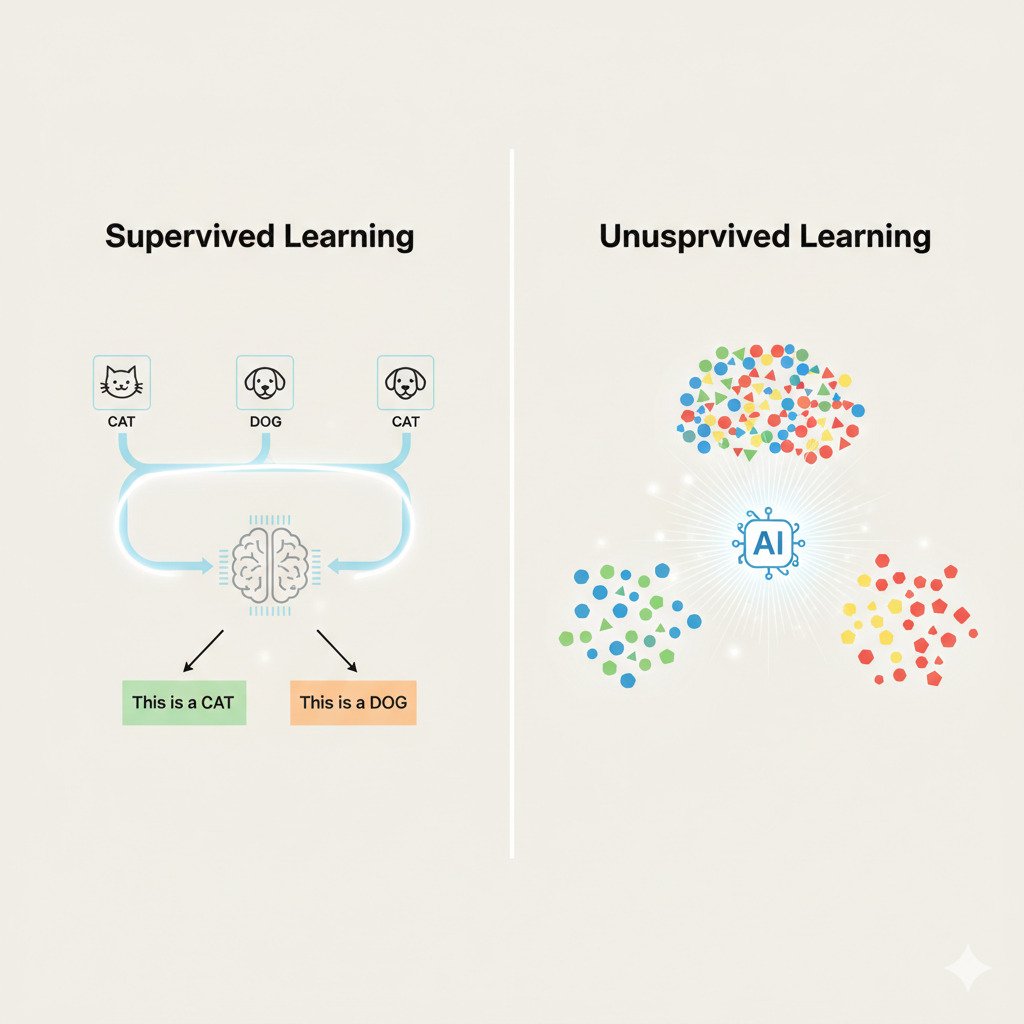
- Image Classification: Showing the AI thousands of pictures labeled “Cat” or “Dog” (x = image pixels, y = “Cat”/”Dog”). The AI learns to classify new, unlabeled images.
- Spam Detection: Providing emails labeled “Spam” or “Not Spam” (x = email text, y = “Spam”/”Not Spam”). The AI learns to filter new emails.
- House Price Prediction: Feeding data about houses (size, location, number of rooms – x) along with their actual sale prices (y). The AI learns to predict the price of a new house based on its features.
Supervised learning is all about prediction and classification, where the AI learns from labeled examples to map inputs to known outputs.
Unsupervised Learning: The Mystery Box of Pieces
Now, imagine a different scenario. You’re given a giant box of puzzle pieces, but there’s no picture on the box lid. You have no idea what the final image is supposed to be.
- The Setup: You’re given a collection of data (x), but there are no labels or correct outputs (y).
- The Goal: Your task is to explore the data and find interesting structures, patterns, or relationships within it on your own. You’re essentially trying to organize the jumbled pieces into meaningful groups or identify outliers.
- Examples:
- Clustering Customers: A company has data on thousands of customers (purchase history, demographics, browsing behavior – x). Without any pre-defined groups, the AI might identify distinct segments of customers (e.g., “frequent high-spenders,” “casual browsers,” “discount hunters”). This is like finding natural clusters of puzzle pieces that seem to belong together.
- Anomaly Detection: Analyzing network traffic data (x) to find unusual patterns that deviate significantly from the norm. This is like finding a single puzzle piece that doesn’t seem to fit anywhere else.
- Dimensionality Reduction: Simplifying complex data with thousands of features into a few key components while retaining essential information. This is like finding the main shapes or patterns within the puzzle pieces to understand the overall picture more easily.
Unsupervised learning is about discovery – finding hidden structures, groupings, or anomalies in unlabeled data.
Two Sides of the Same Coin: Finding Patterns
While the approaches are different – one guided by answers, the other exploring freely – both supervised and unsupervised learning share a fundamental objective: finding meaningful patterns in data.
- Supervised learning uses known answers to train the AI to recognize specific patterns that lead to correct predictions.
- Unsupervised learning uses the inherent properties of the data itself to discover patterns that might not have been obvious beforehand.
Understanding this distinction is key to appreciating the vast landscape of AI techniques. In our next lecture, we’ll start to look at the simplest form of supervised learning: using a straight line to find a pattern, a technique called Linear Regression.
