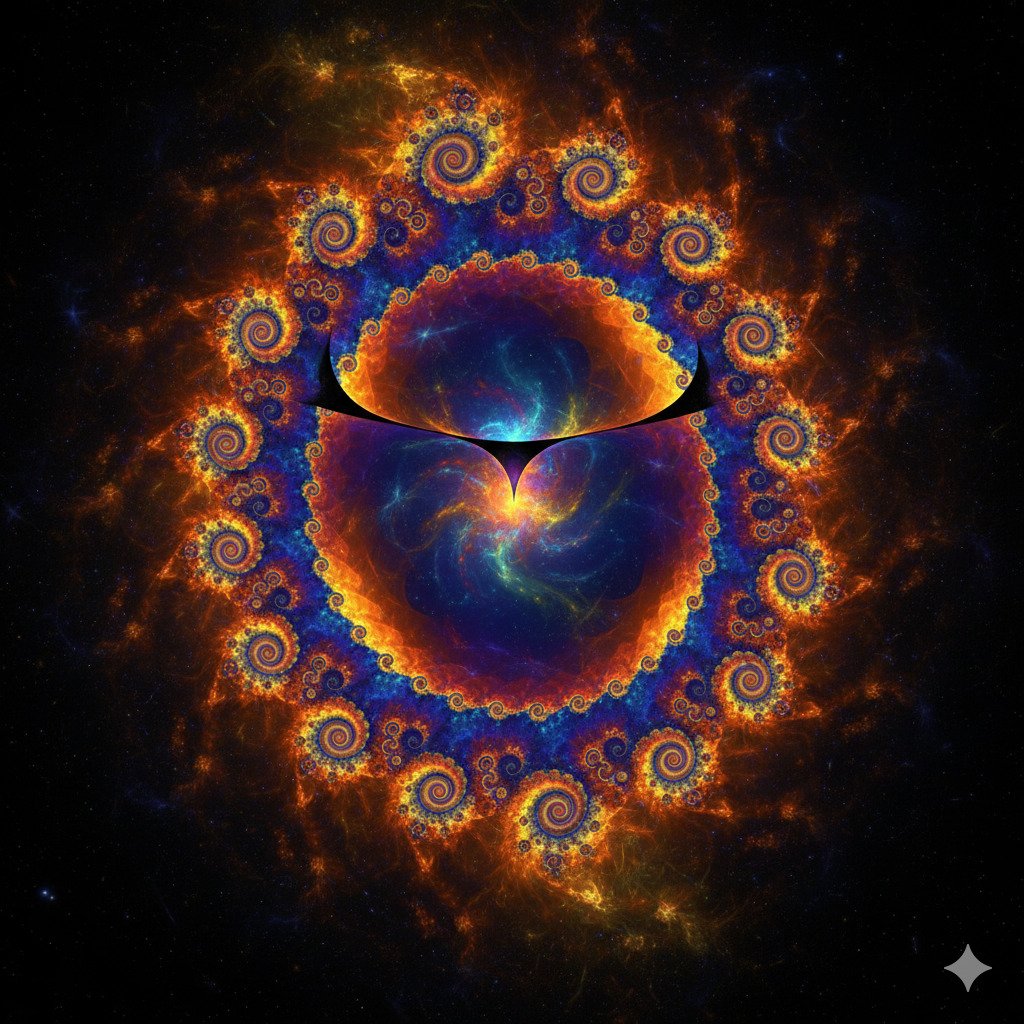
Look at a cloud. Now, think of a coastline on a map. What about the delicate, branching structure of a fern or the jagged beauty of a lightning bolt? For centuries, classical geometry, with its perfect circles, squares, and straight lines, struggled to describe these rough, messy, and infinitely complex shapes of the real world.
Then came a maverick mathematician who gave us a new language to understand this beautiful chaos: Benoît Mandelbrot.
Welcome back to Sequentia! Today, we’re celebrating the visionary mind who coined the term “fractal” and forever changed how we see patterns in the universe.
Who Was Benoît Mandelbrot?
Born in Poland in 1924, Benoît Mandelbrot was a brilliant and unconventional thinker. He saw connections where others saw none, bridging disciplines from mathematics and physics to economics and biology. He was a pioneer in using early computers to visualize mathematical concepts, believing that sight was a powerful tool for understanding.
His core frustration was that nature simply wasn’t smooth. As he famously said, “Clouds are not spheres, mountains are not cones, coastlines are not circles, and bark is not smooth, nor does lightning travel in a straight line.” He needed a new kind of geometry to describe this “roughness”—and so, he developed fractal geometry.
What is a Fractal, Anyway?
At its heart, a fractal is a never-ending pattern that is self-similar across different scales.
What does “self-similar” mean? Imagine zooming in on a fern frond. The smaller parts of the frond look just like the whole thing, only smaller. Zoom in again on an even smaller part, and the pattern repeats. A single branch of a tree often resembles a miniature version of the entire tree. This property of having a repeating pattern at every level of magnification is the signature of a fractal. It’s infinite complexity born from a simple, repeating rule.
The Masterpiece: The Mandelbrot Set
Mandelbrot’s most famous discovery is the iconic shape that now bears his name: the Mandelbrot set.
This bizarre, beetle-like shape is not a drawing; it’s a visualization of the results of a surprisingly simple mathematical equation (z = z² + c) applied over and over again. Every point on the computer screen is tested with this equation. Depending on the result, the point is given a color.
The outcome is an object of staggering complexity and otherworldly beauty. You can “zoom in” on its intricate border forever, and new, equally complex patterns—some resembling miniature versions of the whole set—will continue to emerge infinitely. It’s a true mathematical art gallery generated from a simple rule.
Why Fractals Matter to Puzzle Lovers
The world of fractals is a paradise for pattern seekers. It teaches us that:
- Simple rules can create infinite complexity. Just like a sequence puzzle can have a simple rule that generates a long, complex series, the rules behind fractals generate infinite detail.
- Patterns are everywhere, even in chaos. Mandelbrot showed us how to find the mathematical order hidden within the seemingly random and messy parts of our world.
- Visual intuition is powerful. Sometimes, the best way to understand a pattern is to see it.
Benoît Mandelbrot didn’t just invent a new field of mathematics; he gave us a new lens through which to view our universe, revealing a hidden layer of intricate, beautiful, and infinite patterns all around us.
Have you ever been mesmerized by a fractal image or seen a fractal pattern in nature? Share your experience in the comments!
