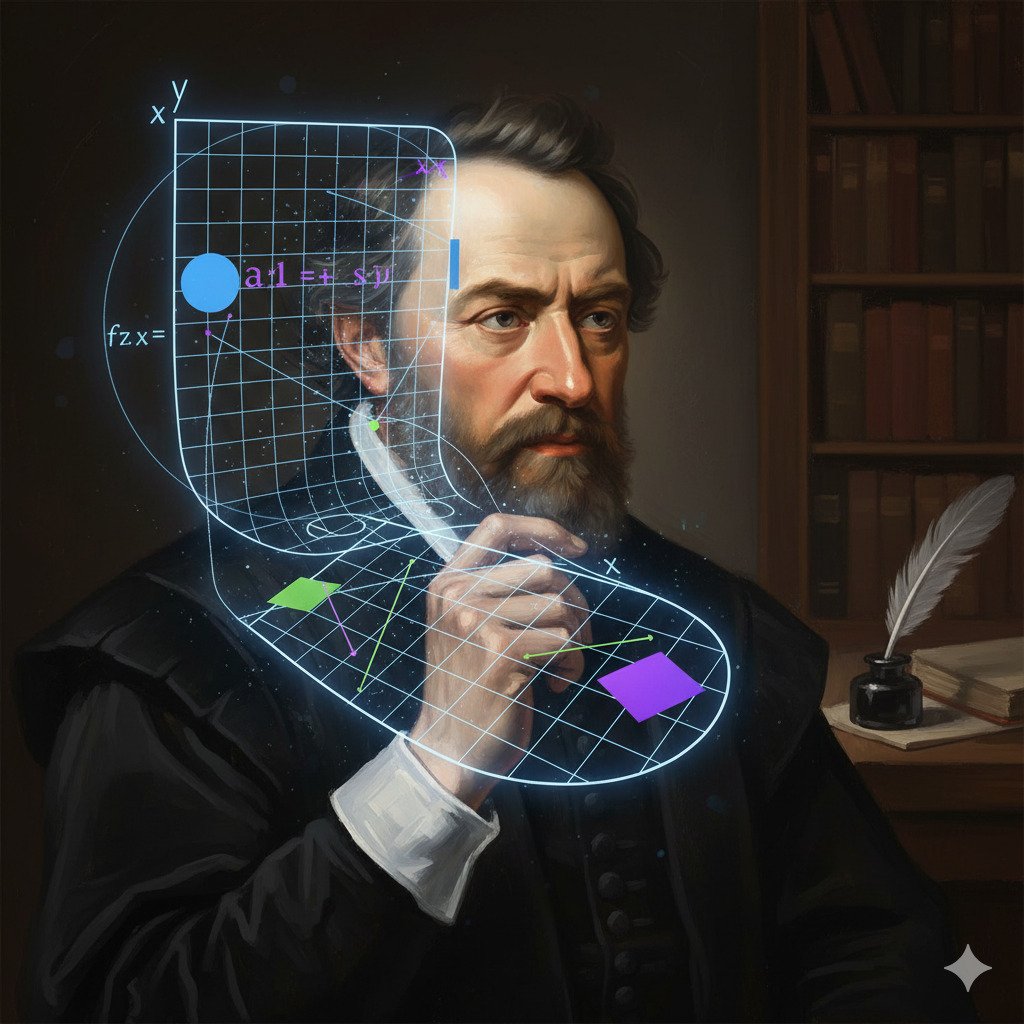
Have you ever used a map in a video game, looked up a location on Google Maps, or even just played a simple game of Battleship? Every time you pinpoint a location on a grid using two values—like “over three, up four”—you are using a revolutionary idea conceived not by a game designer or a programmer, but by a 17th-century philosopher.
That philosopher was René Descartes, and his invention, the Cartesian coordinate system, fundamentally changed how we see the world. Welcome back to Sequentia, where today we explore the mind that built a bridge between numbers and shapes!
Who Was René Descartes? More Than Just a Mathematician
Born in France in 1596, René Descartes is most famously remembered in philosophy for his profound statement, “Cogito, ergo sum”—“I think, therefore I am.” He was a foundational figure in the Age of Reason, seeking to build knowledge from the ground up based on logic and certainty.
But his quest for logical certainty wasn’t confined to philosophy. He saw mathematics as the purest form of reasoning and sought to apply its clarity to other fields. In doing so, he solved a problem that had existed for centuries: the separation between algebra (the world of symbols and equations) and geometry (the world of shapes and figures).
The “Aha!” Moment: Bridging Two Worlds
Before Descartes, algebra and geometry were largely treated as separate disciplines. You worked with equations, or you worked with shapes. There was no easy way to describe a circle using an equation, or to visualize what an equation might “look” like.
Descartes’ brilliant insight was to merge them using a simple grid. By drawing two perpendicular number lines—the x-axis (horizontal) and the y-axis (vertical)—he created a “plane” where any point could be uniquely described by a pair of numbers, its coordinates (x, y).
This simple grid acted as a powerful dictionary, translating the language of algebra into the visual language of geometry, and vice versa.
- An equation like y = x + 1 was no longer just a string of symbols; it became a straight line you could see and draw on the grid.
- A shape like a circle was no longer just a drawing; it could be perfectly described by an algebraic equation (e.g., x² + y² = 4).
This invention, the Cartesian Coordinate System, named after Descartes, was nothing short of revolutionary.
Why This Matters for Puzzles and Games
So, how does a 17th-century invention impact our modern-day puzzles? In almost every way imaginable!
- Grid-Based Logic: Any puzzle that takes place on a grid, from Battleship and chess to Nonograms and even some advanced Sudoku variants, relies on the principle of coordinates to define positions.
- Computer Graphics: The entire world of computer and video game graphics is built on the Cartesian plane. Every character’s position, every object on the screen, is tracked using x, y (and often z for 3D) coordinates.
- Data Visualization: When you see a graph plotting information, you’re looking at data visualized on a coordinate plane—a puzzle of trends and patterns made visible.
- Visualizing Solutions: The coordinate system allows us to take abstract problems and give them a visual form, making them easier to understand and solve. It allows us to see the patterns we’re looking for.
René Descartes didn’t just give us a tool for math class; he gave us a new way of thinking—a framework for organizing space and visualizing relationships. It’s a testament to how a single, logical idea can provide the foundation for centuries of innovation, from mapping the globe to designing the virtual worlds we love to explore.
What’s your favorite grid-based game or puzzle? Let us know in the comments!
