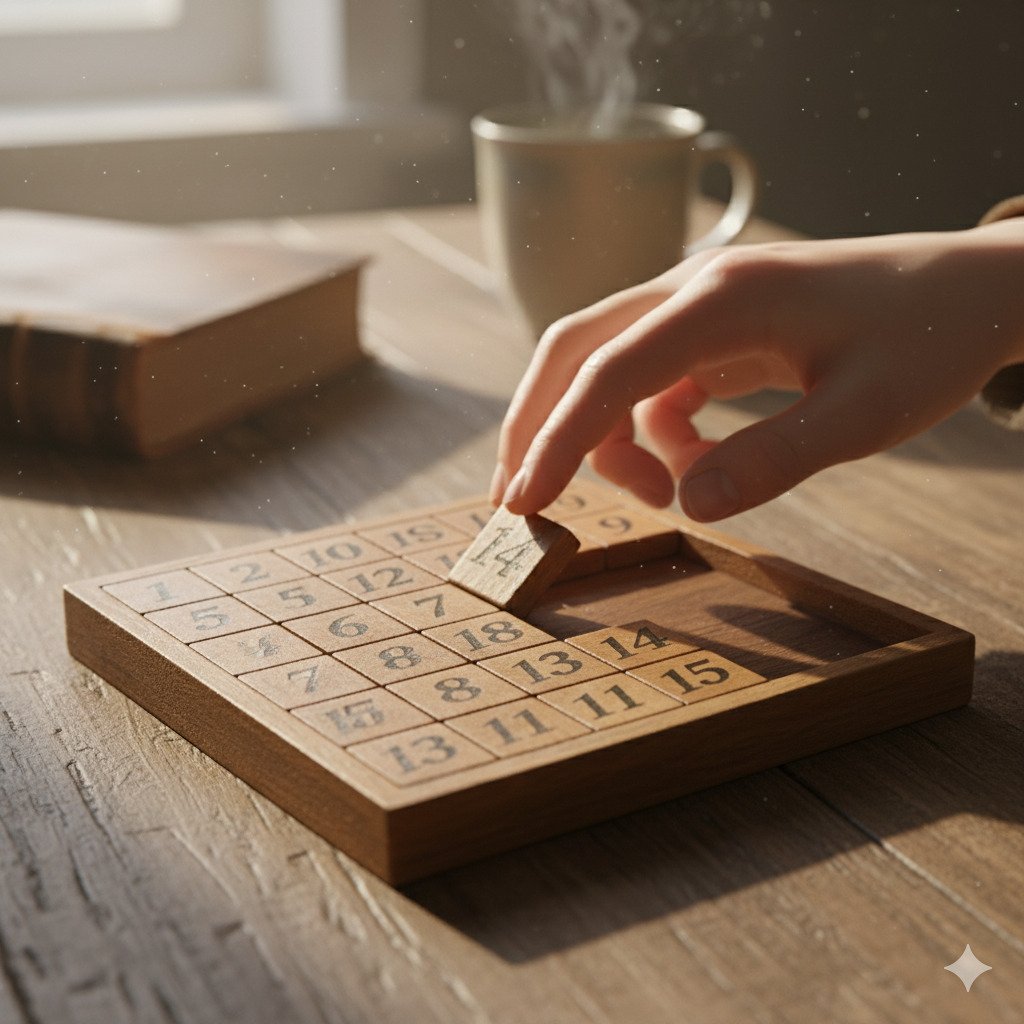
That familiar, satisfying clack of a plastic tile sliding into an empty space. For many of us, the sliding block puzzle is a core memory from childhood—a simple, portable challenge found in toy boxes and travel bags. At the heart of this puzzle family lies its most famous member: the 15 Puzzle.
Deceptively simple on the surface, this grid of numbered squares holds a surprising mathematical secret that once stumped an entire nation. Welcome to Sequentia, where today we’re sliding into the rich history and hidden logic of the 15 Puzzle.
What is the 15 Puzzle?
The classic 15 Puzzle consists of a 4×4 grid with 15 numbered square tiles and one single empty space. The objective is straightforward: start with the tiles in a scrambled configuration and, by sliding them one at a time into the adjacent empty space, arrange them in numerical order from 1 to 15, leaving the final space empty.
123456789101112131415--
It sounds easy enough, right? Just keep sliding until they fall into place. But as many have discovered, it’s not always that simple.
A Puzzle That Drove America Mad: The Story of Sam Loyd
The puzzle exploded in popularity in the 1880s, becoming a worldwide craze. The famous American puzzle-maker Sam Loyd is often credited with its popularization, and he brilliantly fueled the frenzy by offering a $1,000 prize (a fortune at the time!) for anyone who could solve a specific starting configuration.
His challenge? A standard grid, but with the 14 and 15 tiles swapped.
People were obsessed. They spent countless hours sliding tiles, convinced the solution was just a few moves away. But no one ever claimed the prize. Why? Because Loyd knew a secret: the configuration he proposed was mathematically impossible to solve.
The Hidden Math: Why Some Puzzles Are Unsolvable
The secret lies in a mathematical concept related to permutations and “parity.” In simple terms, every time you slide a tile, you are essentially swapping its position with the empty space. The arrangement of the tiles has a hidden property, an “orderliness” that can be calculated.
It turns out that from any given starting position, you can only reach half of all possible tile arrangements. The other half is forever inaccessible through legal sliding moves. By simply swapping the 14 and 15, Loyd created a puzzle that was in the “unsolvable” half. No matter how clever you were, you could never slide the tiles from his starting position into the perfectly ordered solution. It was a brilliant and slightly mischievous mathematical trick!
Your Challenge: The 8 Puzzle
Let’s try a smaller, more manageable version called the 8 Puzzle (a 3×3 grid). The goal is to get the numbers in order from 1 to 8. This starting position is solvable!
1-- 3425786
Can you slide the tiles to reach the goal state below?
Goal State:
12345678--
Hint: Think about the path the empty space needs to take. Sometimes working a few steps backward from the solution can reveal the right moves!
The 15 Puzzle is a timeless testament to how simple rules can create profound complexity. It’s more than just a game—it’s a hands-on lesson in logic, problem-solving, and the beautiful, unchangeable laws of mathematics.
Have you ever solved a 15 Puzzle? Share your memories or your solution to the 8 Puzzle challenge in the comments!
