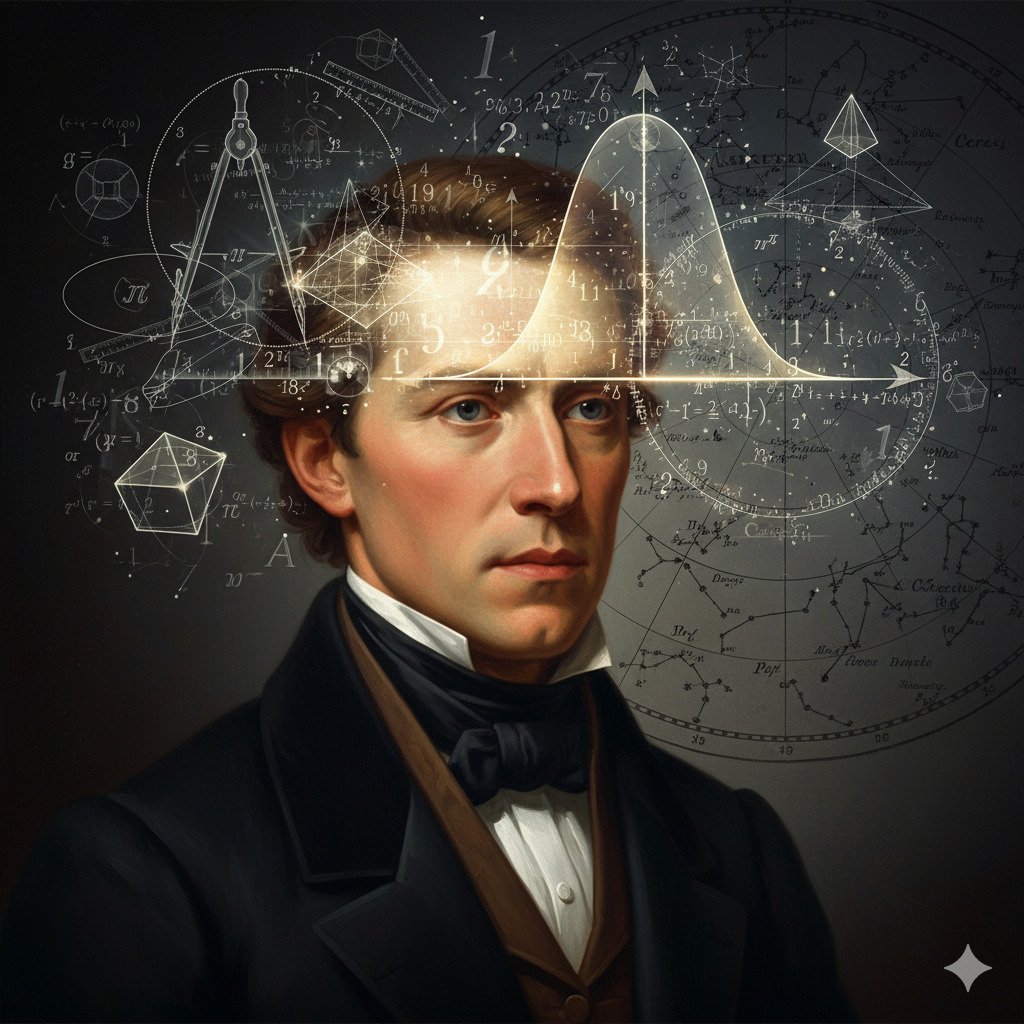
In the world of mathematics, a few names stand tall, their genius shaping centuries of thought. Isaac Newton, Leonhard Euler, Archimedes. And among them, often hailed as the “Princeps Mathematicorum” – the Prince of Mathematicians – is Carl Friedrich Gauss. His contributions are so vast they touch nearly every branch of modern math and science.
But to truly understand his incredible mind, we don’t need to start with his complex theorems. We can start with a simple story from his childhood, a legendary “Aha!” moment that every puzzle solver can appreciate.
The Busy-Work Problem That Revealed a Genius
The story, now a classic tale, goes like this: A young Gauss, around eight years old, was in a tedious arithmetic class. To keep the students busy, the teacher gave them a seemingly long and laborious task: “Add up all the integers from 1 to 100.” The teacher expected this to take a good while.
But mere moments later, while the other students were still painstakingly writing out their sums, young Gauss placed his slate on the teacher’s desk with a single number written on it: 5050.
The teacher was stunned. How could he have been so fast?
Gauss didn’t add the numbers one by one. He saw a hidden pattern. He realized he could pair the numbers: the first with the last (1 + 100 = 101), the second with the second-to-last (2 + 99 = 101), the third with the third-to-last (3 + 98 = 101), and so on.
He saw that there would be 50 such pairs, and each pair would sum to 101. So, the total sum was simply 50 pairs × 101 per pair = 5050. It was a flash of pure insight, a testament to a mind that didn’t just compute, but sought out the underlying structure of a problem.
Beyond the Classroom: A Legacy of Discovery
That brilliant pattern-spotting was just the beginning. Gauss’s career was a relentless series of groundbreaking achievements:
- The “Queen of Mathematics”: His monumental work, Disquisitiones Arithmeticae, published when he was just 24, revolutionized number theory—a field he called the “queen of mathematics.”
- Rediscovering a Planet: When the asteroid Ceres was discovered in 1801 and then lost, astronomers were frantic. Using only a few initial observations, Gauss developed a new method for calculating orbits and told them exactly where to look. They pointed their telescopes, and there it was. He had, in essence, solved a cosmic puzzle.
- The Bell Curve: He made enormous contributions to statistics, and the normal distribution, often called the “bell curve,” is also known as the Gaussian distribution in his honor.
- Mapping the World: He applied his genius to geodesy (the science of measuring the Earth), inventing tools and methods that improved map-making and our understanding of the planet’s shape.
The Lesson for Every Puzzle Solver
Gauss’s legacy isn’t just about his incredible intellect; it’s about his approach. He teaches us to:
- Look for the Simple Pattern: Before diving into brute-force calculation, step back. Is there a simpler, more elegant structure hidden within the problem?
- Be Curious: His work spanned pure math, astronomy, and physics. His curiosity drove him to apply his skills to every puzzle the universe presented.
- Master the Fundamentals: His childhood feat was built on a deep, intuitive understanding of basic arithmetic.
Carl Friedrich Gauss was more than a calculating machine; he was a master pattern-spotter. He saw the connections others missed, whether in a simple sum, the orbit of an asteroid, or the very fabric of numbers. And that is a mindset every puzzle enthusiast at Sequentia can aspire to!
