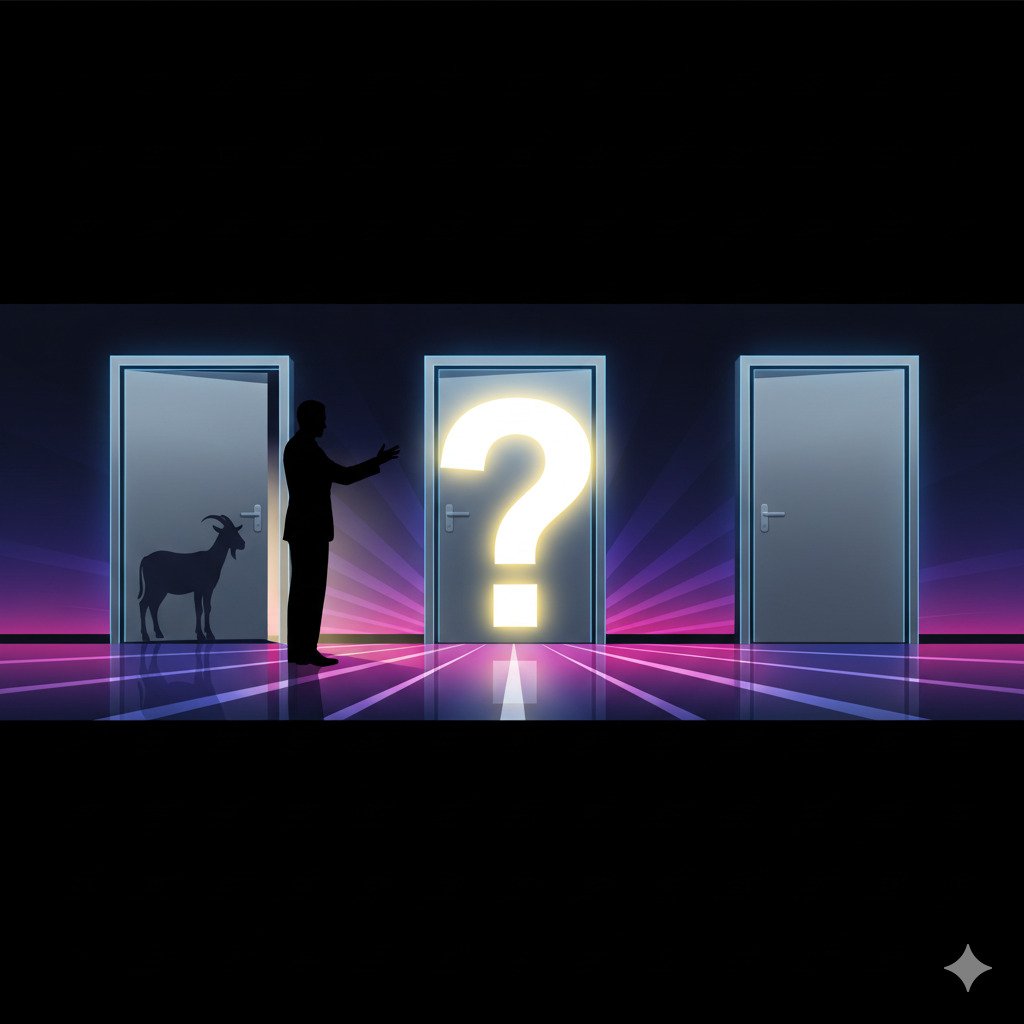
Imagine this: you’re a contestant on a game show. In front of you are three identical closed doors. Behind one door is a brand new car; behind the other two are goats. The host, Monty Hall, asks you to pick a door.
You choose Door #1.
Now, things get interesting. Monty, who knows exactly where the car is, opens one of the other doors, say Door #3, to reveal a goat. He then turns to you with a smile and presents the million-dollar question:
“Do you want to stick with your original choice, Door #1, or do you want to switch to the remaining closed door, Door #2?”
What do you do? Most people’s intuition screams, “It doesn’t matter! There are two doors left, so it’s a 50/50 chance either way.” But what if I told you that intuition is wrong? And not just a little wrong, but statistically very wrong.
Welcome to the Sequentia deep dive into one of the most famous and baffling probability puzzles of all time!
The Counter-Intuitive Answer: You Should Always Switch
Yes, you read that correctly. Your best strategy is to always switch your choice. Switching doors gives you a 2/3 (66.7%) chance of winning the car, while sticking with your initial choice only leaves you with a 1/3 (33.3%) chance.
But why? It feels like it should be 50/50! The key lies in one crucial detail: Monty’s action is not random. He knows where the car is and will always open a door with a goat. His action gives you new information.
Let’s Break it Down Simply
Let’s go back to your first choice. When you picked Door #1, you had a:
- 1/3 chance of being RIGHT (picking the car).
- 2/3 chance of being WRONG (picking a goat).
Now, consider what happens in both scenarios:
- Scenario 1: You Initially Chose the Car (1/3 probability)
- If your first pick was the car, Monty will open one of the two goat doors. If you switch, you lose.
- Scenario 2: You Initially Chose a Goat (2/3 probability)
- This is the more likely scenario! If your first pick was a goat, Monty must open the other goat door. This means the remaining closed door (the one he’s offering you) must have the car. So, if you switch, you win!
Since you had a 2/3 chance of picking a goat in the first place, there is a 2/3 chance that switching will win you the car. Monty’s action essentially concentrates the initial 2/3 probability of you being wrong onto the single remaining door.
The “100 Doors” Analogy That Makes it Click
Still not convinced? Let’s scale it up. Imagine 100 doors. One has a car, 99 have goats.
- You pick one door (Door #1). Your chance of being right is tiny (1%). Your chance of being wrong is massive (99%).
- Monty, who knows where the car is, then opens 98 of the other doors, revealing 98 goats.
- He leaves one other door closed (say, Door #74). He asks, “Do you want to stick with your original Door #1, or switch to Door #74?”
In this scenario, doesn’t it feel overwhelmingly likely that the car is behind Door #74? You made a 1-in-100 shot. Monty then eliminated every other wrong choice for you. The 99% probability that you were initially wrong is now almost entirely focused on that one remaining door. You should absolutely switch!
The three-door problem works on the exact same logic, just in a less dramatic fashion.
The Monty Hall problem is a fantastic lesson in conditional probability and a humble reminder that our gut feelings can sometimes lead us astray in the world of logic.
So, did you get it right on your first try? Does the 100-door example help it make sense? Let us know in the comments!
