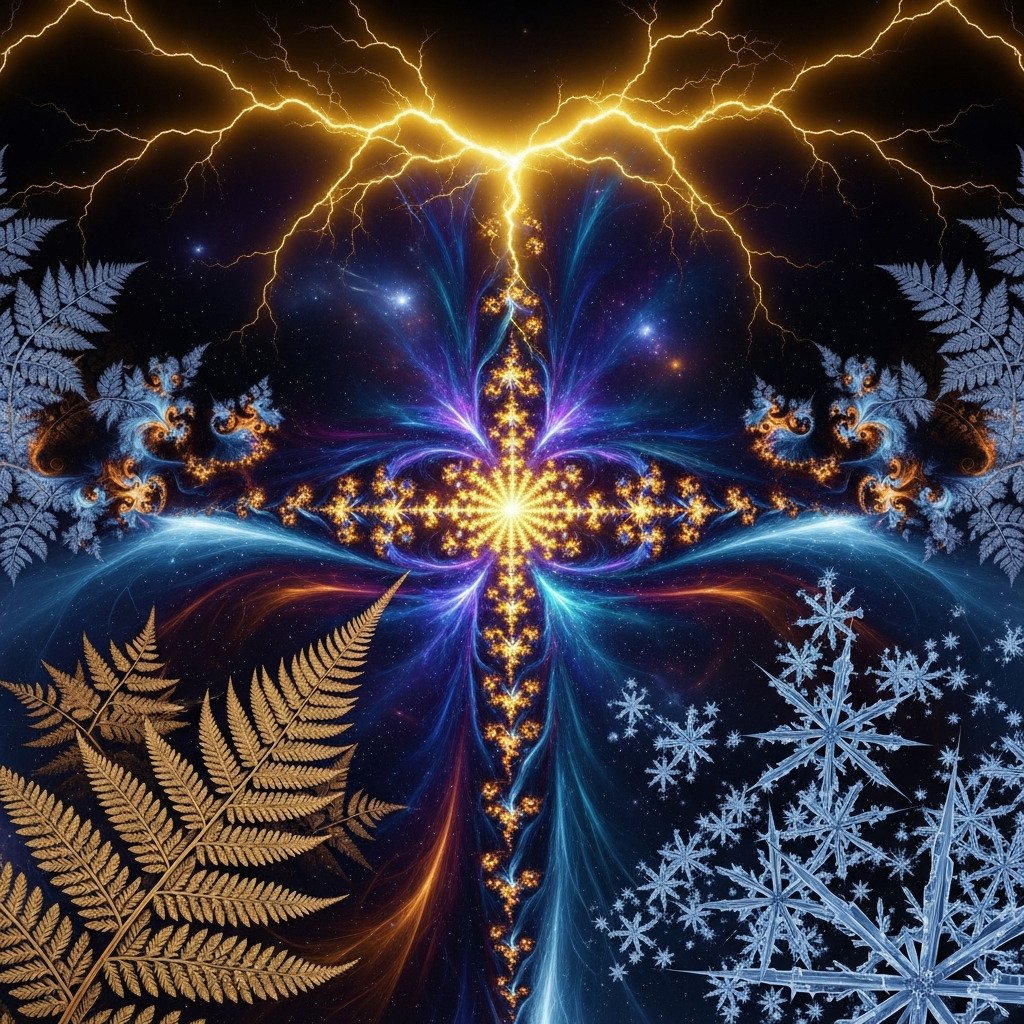
Have you ever zoomed into a digital map and noticed a coastline seems to get more rugged and detailed the closer you look? Or marveled at how a single fern frond looks like a perfect, miniature version of the entire plant? If so, you’ve witnessed the mesmerizing magic of fractals.
These are not just pretty pictures; they are a fundamental part of a mathematical language that describes the beautiful, chaotic complexity of our world. Welcome back to Sequentia, where today we’re zooming into the infinite.
What is a Fractal? The Rule of Self-Similarity
At its core, a fractal is a pattern that never ends. The defining characteristic is self-similarity: as you zoom in on a piece of the fractal, you’ll see a smaller, yet recognizable, version of the whole shape, repeated over and over again, infinitely.
Think of a tree. The trunk splits into large branches. Those branches split into smaller branches, which in turn split into even smaller twigs. Each part echoes the structure of the whole. This is the essence of a fractal pattern. Unlike a simple square or circle, which becomes a straight line or a simple curve when you zoom in, a fractal reveals more and more intricate detail the closer you look.
The Rock Stars of the Fractal World
While nature creates fractals organically, mathematicians have designed some truly mind-bending examples. You’ve likely seen the most famous one:
- The Mandelbrot Set: This iconic, bug-like shape is perhaps the most famous mathematical object in the world. Its swirly, psychedelic boundary contains an infinite number of smaller, distorted copies of itself. Exploring the Mandelbrot Set is like taking a journey through an endless, mathematically generated universe.
- The Sierpinski Triangle: A much simpler but equally elegant fractal. You start with a triangle, remove the middle triangle, and then repeat that process for each of the remaining smaller triangles, forever.
Fractals in Nature: The Blueprint for Life and Chaos
Once you know what to look for, you’ll start seeing fractals everywhere. Nature uses them because they are an incredibly efficient way to build complex structures from a simple set of repeating rules. Look for them in:
- Snowflakes: Each of the six arms of a snowflake is a near-perfect fractal, with smaller branches mirroring the larger ones.
- Lightning Bolts: A bolt of lightning doesn’t travel in a straight line. It forks and branches in a chaotic, fractal pattern as it finds the path of least resistance through the air.
- Romanesco Broccoli: This is perhaps the most stunning and delicious example of a 3D fractal in nature! Each bud is composed of a series of smaller buds, all arranged in a logarithmic spiral.
- Coastlines & Mountain Ranges: A coastline’s length is famously impossible to measure precisely because of its fractal nature. The closer you look, the more little nooks and crannies you find.
Fractals in Puzzles and Games
The principle of self-similarity is a fantastic tool for puzzles! The next time you encounter a visual pattern puzzle, ask yourself: is this a fractal?
- “What comes next?” Puzzles: A sequence of images might show the first few iterations of a fractal, and you have to draw the next stage.
- Pattern Recognition: Many visual logic puzzles rely on you spotting a repeating, self-similar pattern within a larger, more chaotic design.
- Procedural Generation: In modern video games, fractals are often used to generate realistic, infinitely complex landscapes, galaxies, or textures from a simple set of mathematical rules!
Fractals are a beautiful intersection of mathematics, art, and the natural world. They show us that from the simplest repeating rule, infinite complexity and breathtaking beauty can emerge.
Where have you seen a fractal-like pattern recently? Let us know in the comments!
