We all know the classic “spot the difference” puzzle. Two seemingly identical images are placed side-by-side, and your task is to find a handful of subtle cosmetic changes – a missing button, a different-colored flower, a cloud that has moved. It’s a fun test of visual acuity.
But what if we took that concept and gave it a logical, mathematical spin? What if the “difference” wasn’t just a misplaced object, but a broken pattern, a flawed symmetry, or an illogical element?
Welcome to Sequentia, where we’re leveling up this classic puzzle!
Beyond a Missing Button: The Logical Flaw
In a standard spot-the-difference puzzle, you’re looking for purely visual discrepancies. In a mathematical version, you’re looking for a flaw in the underlying system of the image. The change violates a rule, a sequence, or a geometric property. This elevates the puzzle from a simple visual scan to a genuine test of pattern recognition and logical reasoning.
What Kind of “Twists” to Look For?
Instead of just scanning randomly, you’ll need to analyze the image for its hidden rules. Here are some common mathematical twists to keep an eye out for:
- The Broken Sequence: A repeating pattern of shapes, numbers, or colors is established (e.g., Circle, Square, Triangle, Circle, Square…). In one image, an element is out of order.
- The Rule Breaker: The image follows a set rule (e.g., “all numbers inside circles are even,” or “all triangles point up”). In the second image, one element defies this rule.
- The Symmetry Flaw: One image is perfectly symmetrical along an axis, while the other has a single element that breaks this symmetry.
- The Geometric Imposter: All shapes are squares, but in the second image, one is secretly a rhombus. All lines are parallel, but one is slightly skewed. An angle that should be 90 degrees is slightly off.
- The Incorrect Sum: The image contains groups of objects or numbers. In one version, the sum or count in a specific group is different.
Let’s Try One: A Sequentia Challenge
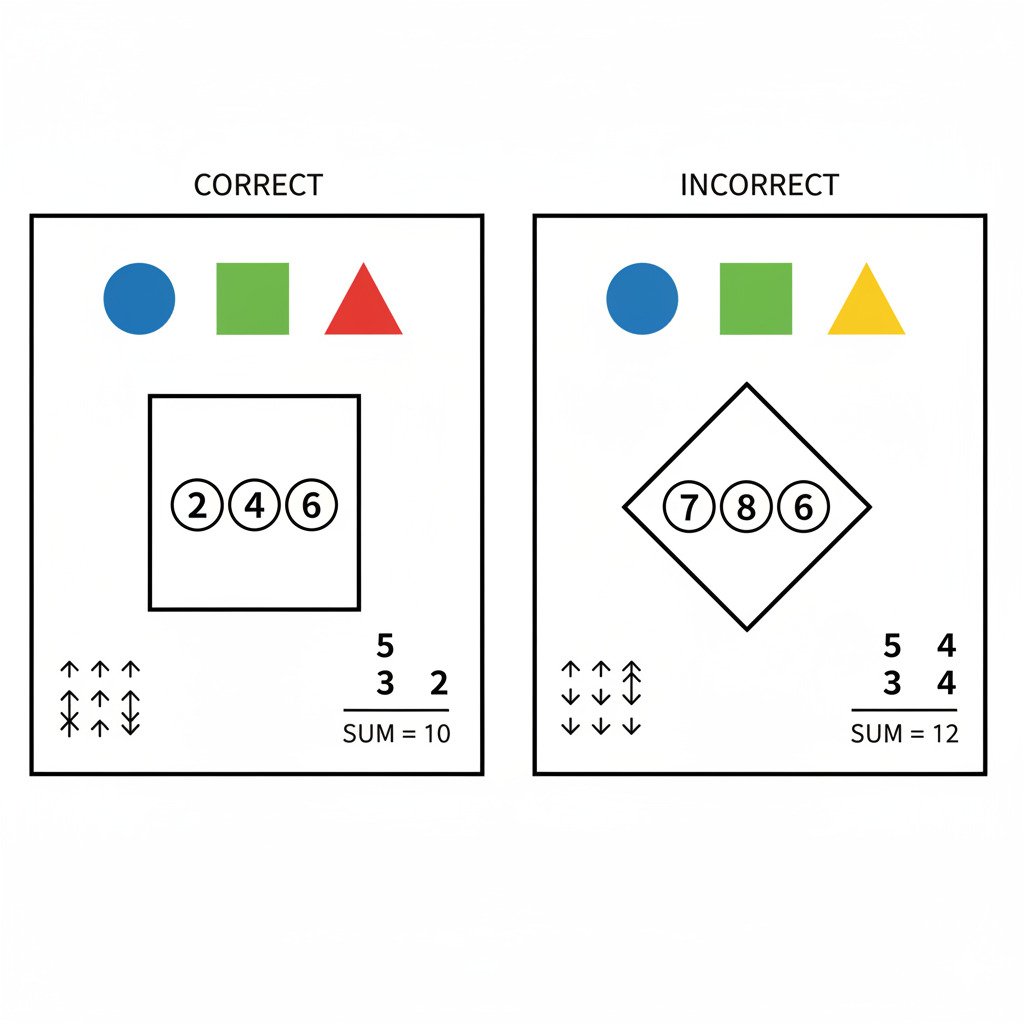
Below are two images. They contain five differences, but these aren’t just random changes. Each difference is a violation of a logical or mathematical rule established in the “correct” image (on the left). Can you find all five logical flaws?
Hint: Look for patterns in the numbers, the colors of the shapes, the direction of the arrows, the type of geometric shapes, and the overall symmetry.
…
Solution Analysis:
- Broken Sequence: In the top row, the color pattern (Blue, Green, Red) is broken in the right image.
- Rule Breaker: All numbers in circles are even in the left image, but the right image has a circle with the number 7.
- Symmetry Flaw: The pattern in the bottom-left corner is symmetrical in the left image but not in the right.
- Geometric Imposter: The large square in the center is a perfect square on the left, but slightly skewed into a rhombus on the right.
- Incorrect Sum: The numbers in the far-right column add up to 10 on the left, but a different sum on the right.
Why These Puzzles are Great for Your Brain
This style of puzzle does more than just train your eyes. It forces your brain to switch between two modes of thinking: broad pattern recognition (identifying the rules) and focused attention to detail (finding the element that breaks the rule). It’s a fantastic workout for your analytical and logical reasoning skills!
Have you ever seen puzzles like this? What other mathematical twists can you think of? Share your ideas in the comments!
