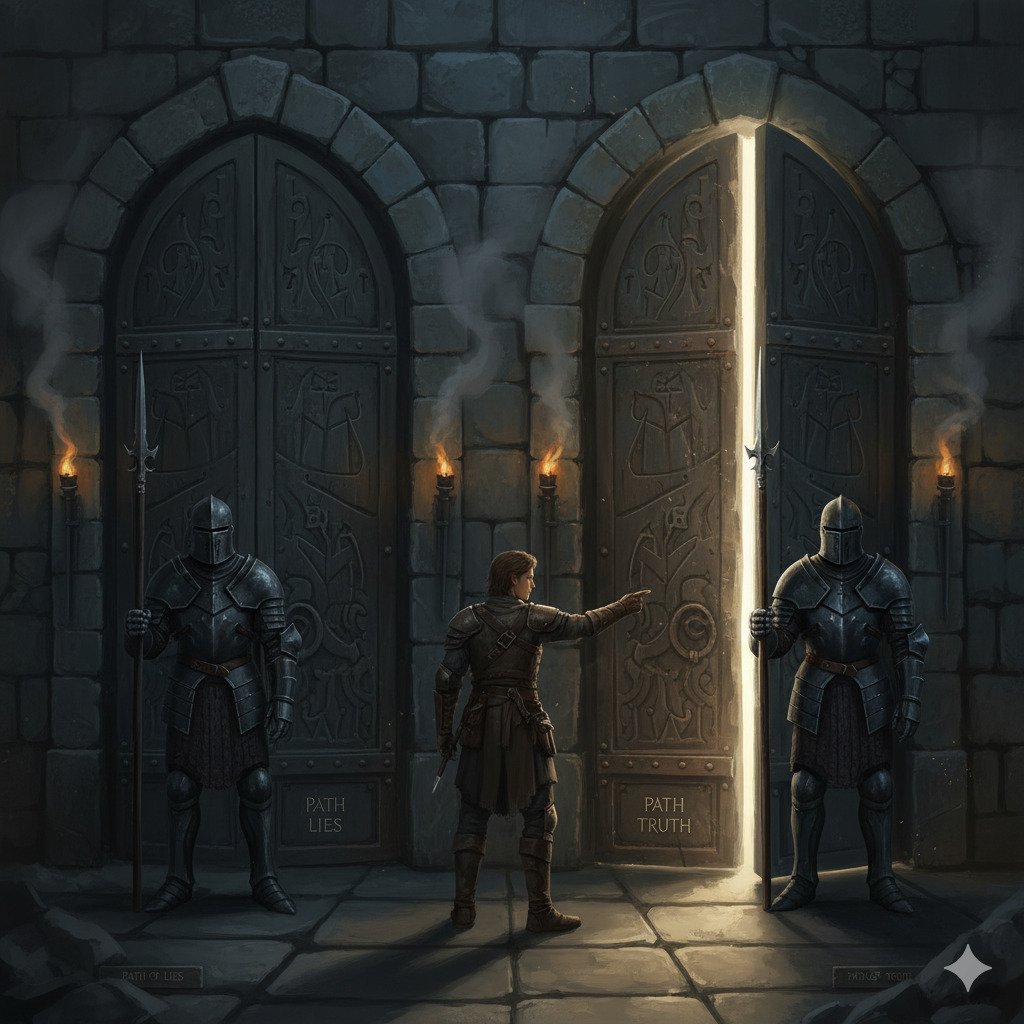
Imagine you are at a critical fork in the road. Before you stand two identical doors. One leads to freedom and riches; the other, to certain doom. In front of each door stands a guard, both identical in appearance.
Here’s the catch: one guard always tells the truth, and the other always lies. You have no idea which is which. You are allowed to ask one single question to one single guard to determine your fate. What question do you ask?
This is one of the most famous logic puzzles of all time, a true test of lateral thinking. Welcome back to Sequentia, where today we’re going to break it down.
Thinking Through the Problem: Why Simple Questions Fail
Before we get to the solution, let’s understand why the most obvious questions don’t work.
- If you point to a door and ask, “Does this door lead to freedom?” you’re stuck. If the guard says “Yes,” it could be the truth-teller pointing to the correct door, OR it could be the liar pointing to the wrong door. You learn nothing for certain.
- If you ask a guard, “Are you the truth-teller?” you’ll always get the answer “Yes.” The truth-teller will truthfully say he is, and the liar will lie and also say he is. Again, you learn nothing.
The key isn’t to find out which door is correct or which guard is trustworthy directly. The key is to craft a question where the answer gives you the information you need, regardless of who you ask.
The “Aha!” Moment: The Magic Question
The solution lies in asking a question that forces both the liar and the truth-teller to point you toward the same, predictable outcome. Here is the life-saving question:
“If I were to ask the other guard which door leads to freedom, what would he say?”
Let’s break down why this piece of logical genius works perfectly. There are two scenarios:
Scenario 1: You happen to ask the Truth-teller.
- The truth-teller knows that the other guard is the liar.
- He also knows that the liar would point to the door of doom.
- Since he must tell the truth, he will truthfully tell you what the liar would say.
- Result: The truth-teller points to the door of doom.
Scenario 2: You happen to ask the Liar.
- The liar knows that the other guard is the truth-teller.
- He also knows that the truth-teller would point to the door of freedom.
- Since he must lie, he will lie about what the truth-teller would say.
- Result: The liar points to the door of doom.
The Inescapable Conclusion
Did you spot the pattern? In both scenarios, no matter which guard you ask, the door they point to is guaranteed to be the door of doom.
So, you simply ask the question, listen to their answer, and then confidently walk through the opposite door to your freedom!
This puzzle is a beautiful example of using the established rules of a system (one always lies, one always tells the truth) against itself to produce a reliable result. It’s not just about the answer you get, but about understanding the logical framework that produces it.
Have you heard of other variations of this puzzle? Let us know in the comments!
