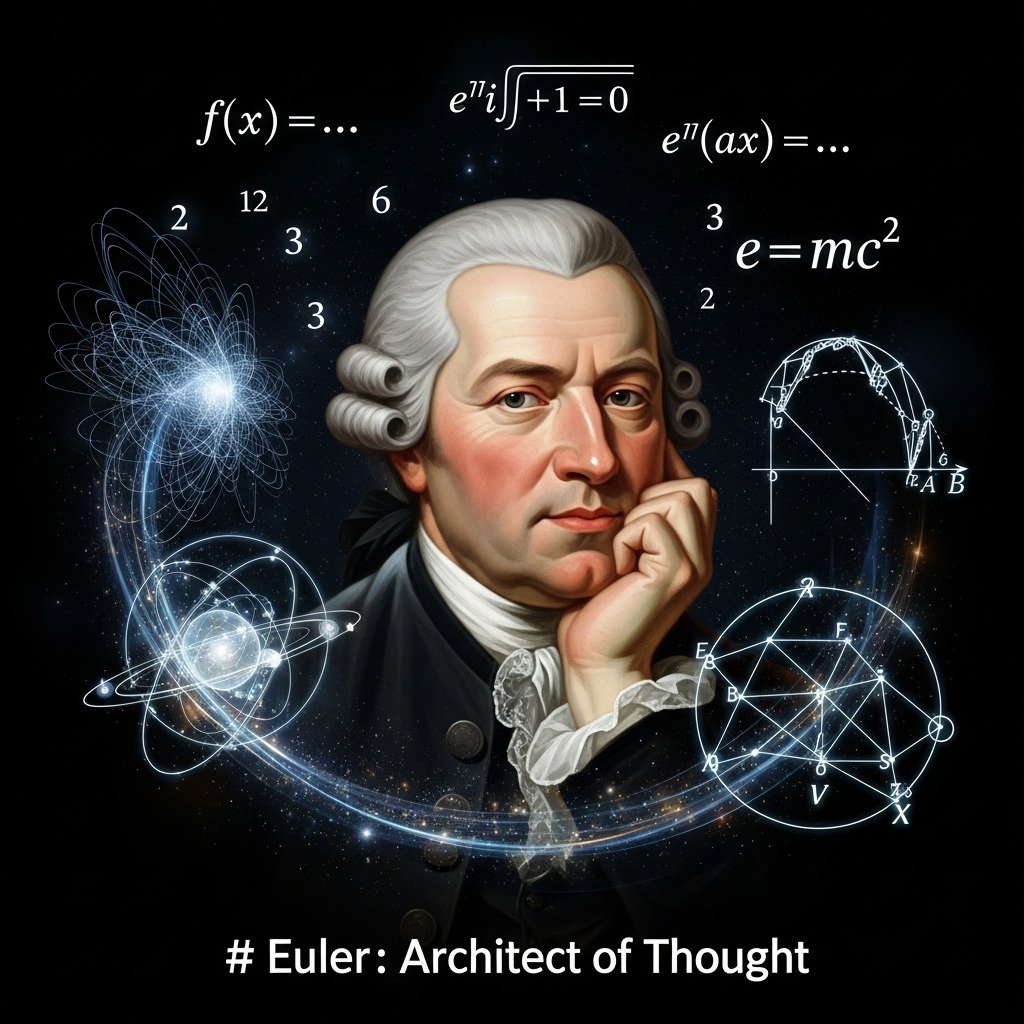
In the grand story of mathematics, some names stand out as pillars, shaping the very language we use to understand the universe. Isaac Newton gave us calculus, Pythagoras gave us his famous theorem. But if there were one mind whose work was so vast, so foundational, and so incredibly prolific that it touched nearly every corner of mathematics, it would be Leonhard Euler (pronounced “Oiler”).
Many argue he is the single most influential and productive mathematician who ever lived. So, who was this 18th-century giant, and how did a simple city puzzle lead him to create an entirely new field of mathematics? Welcome to Sequentia, where today we meet a true master of the numbers.
A Mind of Unprecedented Output
Born in Switzerland in 1707, Leonhard Euler’s lifetime output is staggering. His collected works, the Opera Omnia, span over 80 large volumes, making him by far the most prolific mathematician in history. He made profound contributions to geometry, trigonometry, calculus, number theory, graph theory, and even physics, mechanics, and music theory.
Much of the mathematical notation we take for granted today was popularized by Euler. Ever used f(x) for a function, e for the base of the natural logarithm, i for the imaginary unit, or the Greek letter Σ (Sigma) for summation? You can thank Euler for making them standard. He literally wrote the language of modern mathematics.
The Puzzle That Created a New Field of Math
For puzzle lovers, Euler’s most famous contribution began with a real-world brain teaser: The Seven Bridges of Königsberg. The city of Königsberg, Prussia (now Kaliningrad, Russia) was set on a river and included two large islands. These landmasses were connected to each other and the mainland by seven bridges.
The puzzle that circulated among the townspeople was simple: Could a person take a walk through the city, crossing each of the seven bridges exactly once?
Many tried, and all failed, but no one could prove why. When the problem reached Euler, he had a revolutionary insight. He realized that the exact path you took and the size of the landmasses didn’t matter at all. The only thing that mattered was the relationship between the land and the bridges.
He simplified the problem into a diagram of points (vertices) representing the landmasses and lines (edges) representing the bridges. He proved that to travel a path crossing each edge exactly once, the graph must have either zero or two vertices with an odd number of edges connected to them. The Königsberg graph had four. Therefore, the walk was mathematically impossible.
In solving this puzzle, Euler didn’t just find an answer; he invented Graph Theory, a field of mathematics that is now the foundation for everything from modern computer networks and airline logistics to social media connections and DNA sequencing.
A Mind That Overcame All Obstacles
Euler’s genius was matched only by his perseverance. He possessed a legendary memory and could perform immense calculations in his head. This ability became crucial as his eyesight began to fail. Despite becoming almost completely blind in his later years, his productivity increased. He simply dictated his complex formulas and papers to his sons and scribes.
Leonhard Euler showed us that the essence of mathematics isn’t just about rigid formulas; it’s a creative and powerful tool for solving problems, whether it’s a simple city puzzle or the mechanics of the solar system. He embodies the spirit of Sequentia: the relentless curiosity and the profound satisfaction of finding an elegant solution.
