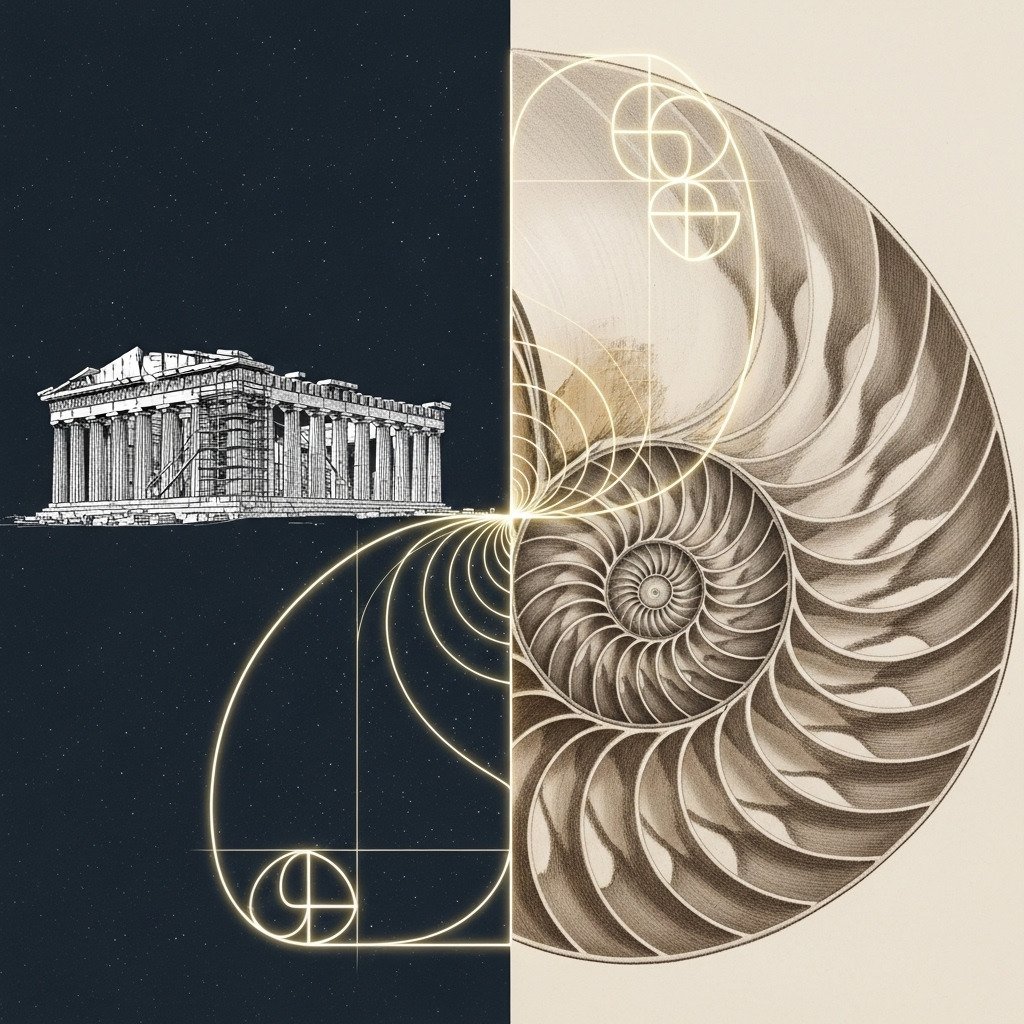
From the majestic proportions of the Parthenon in Athens to the enigmatic smile of the Mona Lisa and the perfect spiral of a nautilus shell, one number is often cited as the secret key to beauty and design: the Golden Ratio. Also known as the Divine Proportion, this mathematical constant has been hailed for centuries as a universal blueprint for aesthetic perfection.
But is this reputation fact or a fascinating mathematical folklore? Welcome back to Sequentia, where today we’re exploring Phi (φ), the number that has captured the imagination of artists, architects, and mathematicians alike.
What Exactly is the Golden Ratio?
The Golden Ratio is an irrational number, approximately equal to 1.6180339887…. It’s often represented by the Greek letter Phi (φ). The unique property of this ratio is that if you divide a line into two parts, the ratio of the whole line to the longer part is the same as the ratio of the longer part to the shorter part.
This proportion is considered to be exceptionally pleasing to the human eye, creating a sense of natural balance and harmony.
The Unbreakable Bond with Fibonacci
Remember our last post on the Fibonacci sequence (1, 1, 2, 3, 5, 8…)? Here’s where things get truly interesting. If you take any two successive numbers in the Fibonacci sequence, their ratio is very close to the Golden Ratio. And the further you go in the sequence, the closer that ratio gets to Phi!
- 8 / 5 = 1.6
- 13 / 8 = 1.625
- 144 / 89 = 1.6179…
This intrinsic link means that wherever Fibonacci patterns appear in nature—like in the spirals of a sunflower or a pinecone—the Golden Ratio is also present, guiding the proportions of that growth.
Fact or Folklore: Where is it Really Found?
The legend of the Golden Ratio is vast. It’s claimed to be in:
- Ancient Architecture: The Pyramids of Giza, the Parthenon.
- Renaissance Art: The works of Leonardo da Vinci, such as the Vitruvian Man and the Mona Lisa.
- Nature: The proportions of the human body, the spiral of a nautilus shell, the shape of galaxies.
But here’s the twist. While some of these examples hold up to scrutiny, many modern mathematicians and scientists argue that the prevalence of the Golden Ratio is often exaggerated. In some cases, measurements are tweaked to fit the ratio, or humans, as excellent pattern-seeking creatures, simply find patterns that may not have been intentional. The nautilus shell, for instance, grows in a logarithmic spiral, but its specific ratio isn’t a perfect match for Phi.
So, What’s the Verdict?
The Golden Ratio remains a captivating enigma. It is undeniably a number with fascinating mathematical properties and a real connection to the Fibonacci sequence and natural growth patterns. However, its reputation as a universal secret to all beauty might be more myth than reality.
Perhaps its true power lies not as a rigid rule, but as a symbol of the elegant and often surprising intersection of mathematics, art, and the natural world. It reminds us to look for hidden patterns and appreciate the inherent harmony in the world around us—the very essence of what makes puzzle-solving so rewarding!
What do you think? Is the Golden Ratio a divine blueprint for beauty, or a beautiful coincidence we love to find? Let us know in the comments!
