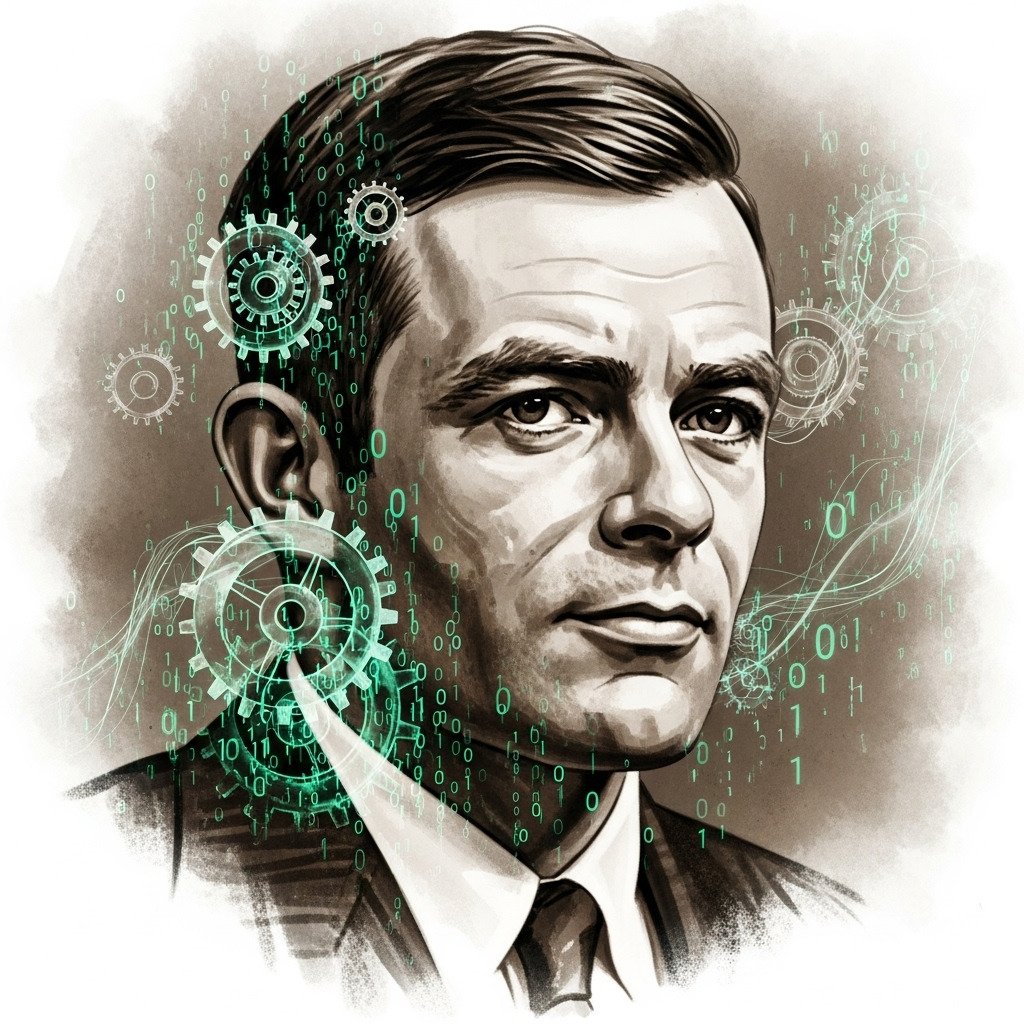
In the world of logic, computation, and puzzles, few names loom as large as Alan Turing. Often hailed as the father of theoretical computer science and artificial intelligence, Turing was a brilliant mathematician whose mind thrived on complex, abstract problems. Yet his most famous triumph was intensely practical: leading the effort to break the seemingly unbreakable codes of Nazi Germany’s Enigma machine during World War II.
Today at Sequentia, we honor a true giant of logical thinking, a man whose work not only helped win a war but also laid the very groundwork for the digital age we live in.
The Enigma Puzzle: A Nightmare of Permutations
To appreciate Turing’s genius, one must first understand the daunting challenge of the Enigma machine. This electromechanical device used a series of rotating rotors and a plugboard to create a polyalphabetic substitution cipher of staggering complexity. With its daily-changing settings, the number of possible combinations ran into the trillions upon trillions. Brute-forcing the code was impossible; intercepting a message without the day’s key rendered it as meaningless gibberish.
The Enigma wasn’t just a machine; it was the ultimate daily logic puzzle, one where failure had life-or-death consequences. For the Allies, it was a race against time to find a logical “shortcut” into this cryptographic maze.
Turing’s Bombe: A Machine to Beat a Machine
Working at the legendary Bletchley Park, Britain’s top-secret codebreaking center, Turing and his team didn’t try to solve the Enigma’s puzzle with pen and paper alone. Instead, they conceived of a machine to fight the machine.
Turing’s key insight was building upon earlier Polish work to design the “Bombe,” a massive electromechanical device. The Bombe didn’t brute-force every possibility. Instead, it ingeniously tested for logical contradictions based on a “crib” – a piece of guessed or known plaintext (like a standard weather report “Wettervorhersage”). By systematically running through rotor settings, the Bombe would search for a configuration that didn’t result in a logical impossibility (like a letter being encrypted as itself), rapidly eliminating millions of incorrect settings until only a handful were left for human analysis.
It was a monumental application of formal logic and automated deduction, a process that mimicked a kind of mechanical, high-speed thinking. The work at Bletchley Park is estimated to have shortened the war by several years and saved countless lives.
Beyond Bletchley Park: The Blueprint for the Modern Computer
Turing’s contributions didn’t end with the war. His 1936 paper “On Computable Numbers” introduced the concept of the “Turing machine,” a theoretical model of a general-purpose computer that could simulate any algorithm. This abstract idea forms the fundamental basis of what we now understand a computer to be – a single machine that can be programmed to perform any task, from calculating a spreadsheet to running a video game.
He later designed the ACE (Automatic Computing Engine), one of the first designs for a stored-program computer. His ideas on machine intelligence and his proposed “Turing Test” (an experiment to determine if a machine can exhibit human-like intelligence) ignited the field of Artificial Intelligence.
Alan Turing’s legacy is a powerful reminder that the ability to solve puzzles, to see patterns, and to apply rigorous logic can have world-changing consequences. From cracking cryptographic codes to conceptualizing the very nature of computation, his work stands as a testament to the power of a mind dedicated to unraveling complexity. He was a puzzle solver on the grandest scale imaginable.
