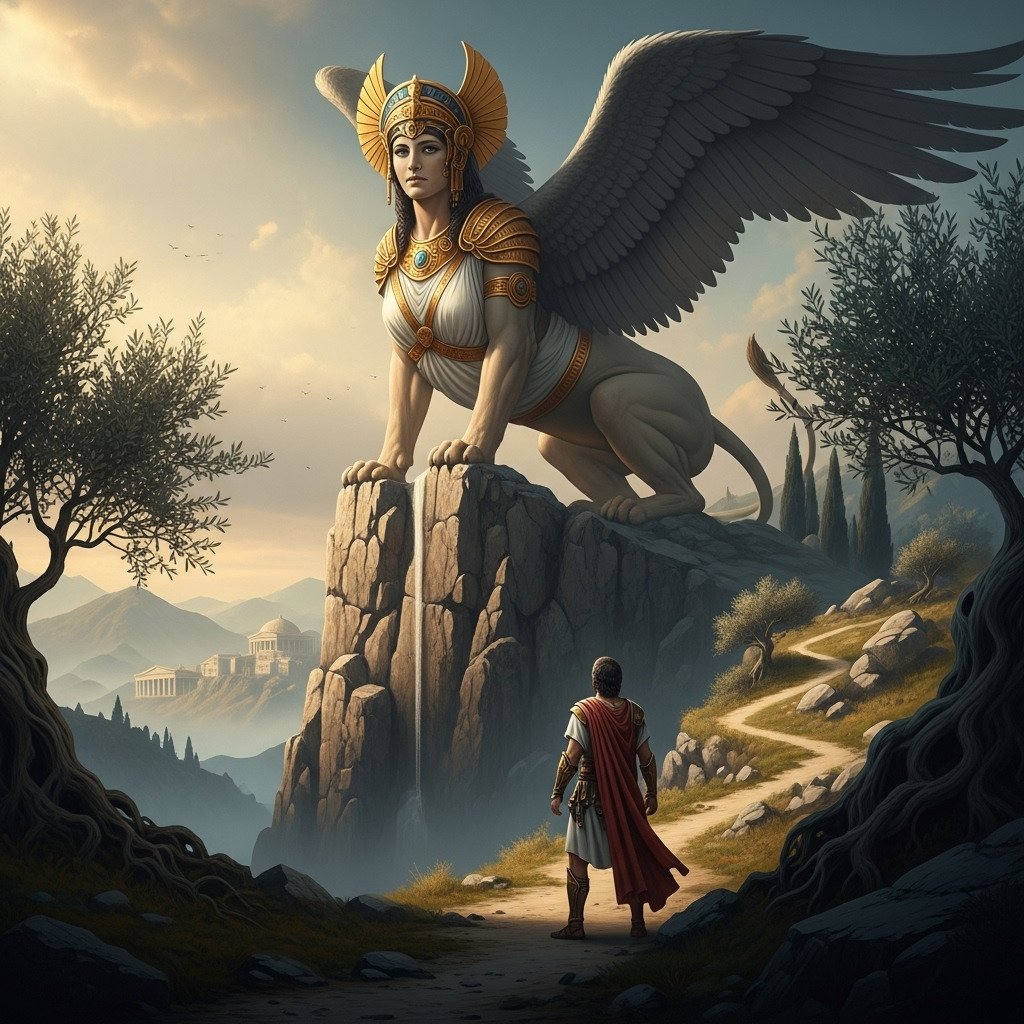
Long before Sudoku grids and complex number sequences, puzzles were woven into the very fabric of mythology and legend. They weren’t just pastimes; they were tests of wit, courage, and wisdom, with life or death often hanging in the balance. Of all these ancient challenges, none is more iconic than the legendary Riddle of the Sphinx.
Welcome back to Sequentia! Today, we journey back to ancient Greece to face the mythical creature whose clever question has echoed through millennia.
The Mythical Encounter in Thebes
According to Greek mythology, the city of Thebes was plagued by a fearsome creature with the head of a woman, the body of a lion, and the wings of a great bird – the Sphinx. Perched on a high rock outside the city gates, she would stop all travelers and pose a single, cryptic riddle. If they failed to answer correctly, she would devour them on the spot. Many had tried, and all had perished, leaving the city in a state of terror.
One day, the hero Oedipus arrived at the gates of Thebes, undaunted by the creature’s reputation. The Sphinx, confident in her intellectual superiority, presented him with her famous riddle:
“What goes on four feet in the morning, two feet at noon, and three feet in the evening?”
The Logic Behind the Riddle
This puzzle is a masterpiece of metaphorical thinking. It doesn’t ask for a creature that literally changes its number of legs. Instead, it uses the “times of day” – morning, noon, and evening – as metaphors for the “stages of life.”
Oedipus, applying his wisdom, saw through the clever misdirection. He thought not about different animals, but about the journey of a single being through its lifespan.
The Solution That Toppled a Monster
Oedipus gave the correct answer:
“Man.”
He explained his reasoning:
- “Four feet in the morning”: As a baby in the “morning” of life, a human crawls on all fours (hands and knees).
- “Two feet at noon”: In adulthood, the “noon” of life, a human walks upright on two feet.
- “Three feet in the evening”: In old age, the “evening” of life, a human often uses a cane for support, which acts as a “third foot.”
Enraged and humiliated at being outsmarted for the first time, the Sphinx, according to legend, cast herself from her rock and perished. Oedipus had saved Thebes not with brute strength, but with pure logic and insight.
Why the Riddle Endures
The Riddle of the Sphinx remains one of the most famous puzzles in history for several reasons:
- It’s a Perfect Metaphor: It elegantly uses familiar concepts (times of day) to represent something profound (the human life cycle).
- It Requires a Shift in Perspective: To solve it, you must stop thinking literally and start thinking metaphorically. This is the essence of many great “Aha!” moments.
- It’s a Story of Brains Over Brawn: It celebrates the power of intelligence to overcome seemingly insurmountable obstacles.
It’s a timeless reminder that the best puzzles challenge not just our ability to calculate, but our ability to think differently. The next time you face a difficult problem, remember Oedipus and the Sphinx – sometimes, the answer lies in looking at the question from a completely new angle.
Have you heard different versions of this riddle, or do you have another favorite from mythology? Share it in the comments!
