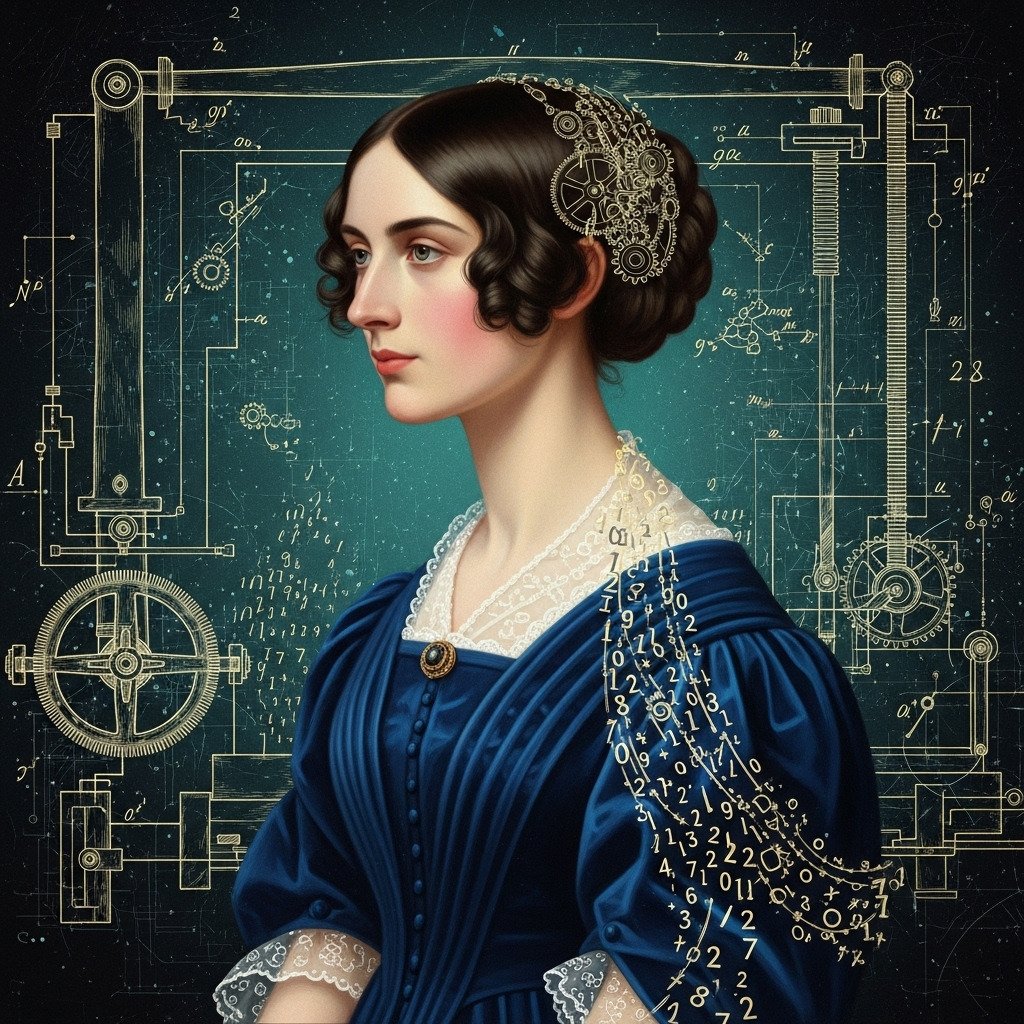
In the world of logic and computing, long before silicon chips and digital screens, a visionary mind saw the future. She looked at a complex machine of cogs and gears, designed purely for number-crunching, and imagined it weaving music, creating art, and manipulating symbols. Her name was Augusta Ada King, Countess of Lovelace, and she is celebrated today as the world’s first computer programmer.
Welcome back to Sequentia’s exploration of the minds behind the puzzles we love. Today, we’re celebrating the “Enchantress of Numbers,” Ada Lovelace.
A Legacy of Science and Poetry
Born in 1815, Ada was the daughter of the famous and rebellious poet Lord Byron. Fearing Ada might inherit her father’s turbulent poetic temperament, her mother, Lady Byron, rigorously pushed her towards mathematics and logic from a young age. This unique upbringing gave Ada a perspective that few possessed: a “poetical science,” where she could see the beauty and creativity within logical systems.
Her mathematical talents flourished, and she began a mentorship and friendship with the brilliant inventor and mathematician, Charles Babbage. Babbage was the mastermind behind the “Difference Engine” and, more ambitiously, the “Analytical Engine.”
The Analytical Engine: A Mechanical Computer
The Analytical Engine was a revolutionary concept – a mechanical, general-purpose computer. It was designed to be programmed using punched cards, could store numbers in a “store” (memory), and process them in a “mill” (CPU). It was, in essence, the blueprint for every computer that followed.
While Babbage was the hardware visionary, Ada Lovelace was the one who truly grasped the machine’s immense potential beyond mere calculation.
“Note G”: The First Computer Program
In 1843, Ada was tasked with translating an Italian article about the Analytical Engine. She didn’t just translate it; she appended her own extensive set of notes, which ended up being three times longer than the original article!
Within these notes, specifically in “Note G,” Ada laid out a detailed, step-by-step sequence of operations for the Analytical Engine to calculate a specific series of numbers (Bernoulli numbers). This set of instructions is now widely considered to be the very first published computer program or algorithm in history.
She didn’t just write a formula; she detailed how the machine’s gears and punched cards would need to process the data, including loops and conditional branching – concepts central to modern programming.
The Vision of a “General-Purpose” Computer
Ada’s most profound contribution was her foresight. She saw that the Analytical Engine’s true power wasn’t limited to numbers. She wrote that the engine “might compose elaborate and scientific pieces of music of any degree of complexity or extent.”
She envisioned a future where a machine could manipulate any kind of information represented by symbols, not just quantities. This conceptual leap from a “number cruncher” to a “general-purpose symbol manipulator” is the very essence of modern computing. She saw the potential for what we now call software, a full century before the first electronic computers were built.
Ada Lovelace’s work is a powerful testament to the creativity inherent in logic and mathematics. She showed us that understanding a system’s rules is the first step to making it sing. Her legacy inspires us to see puzzles not just as problems to be solved, but as languages to be understood and creative systems to explore.
