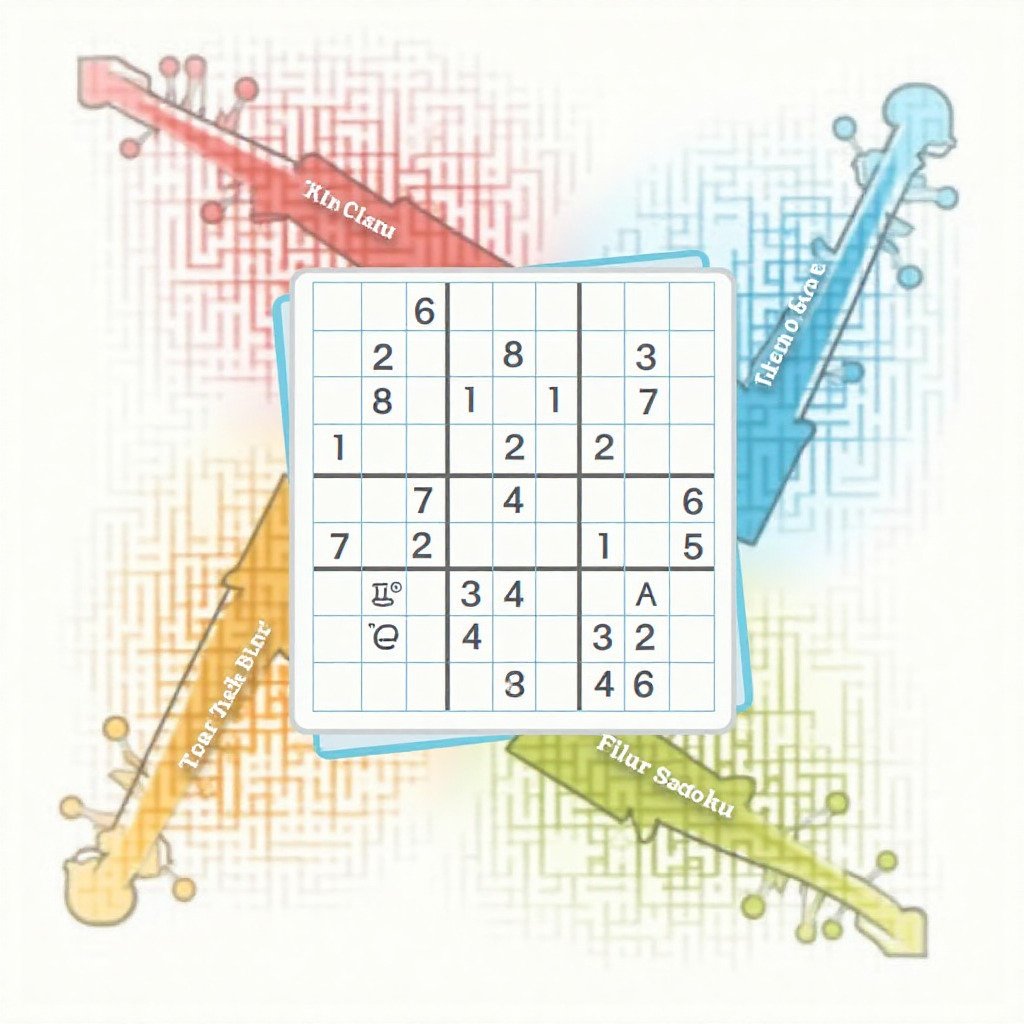
For millions around the globe, Sudoku is the go-to brain teaser – a perfect blend of pure logic and satisfying deduction. The classic 9×9 grid is a familiar friend. But what if I told you that’s just the tip of the iceberg? The world of Sudoku is vast and filled with clever, mind-bending variations that introduce new rules and twist the logic in exciting new directions.
If you’re a Sudoku fan looking for your next challenge, you’re in the right place. Welcome to Sequentia, where today we’re exploring five fantastic Sudoku variants you might not know!
1. Killer Sudoku (Sumdoku)
Don’t let the name scare you! Killer Sudoku is a brilliant hybrid of Sudoku and Kakuro (cross-sums). While the standard Sudoku rules apply (1-9 in each row, column, and 3×3 box), the individual starting clues are gone. Instead, the grid is divided into “cages,” indicated by dotted lines. For each cage, you’re given a single number: the sum of all the digits within that cage. The real challenge? You can’t repeat a digit within a single cage. This adds a layer of arithmetic to the pure logic, making it a favorite for many advanced players.
2. Jigsaw Sudoku (Nonomino or Irregular Sudoku)
Tired of the same old 3×3 boxes? Jigsaw Sudoku is for you! In this variant, the standard 3×3 regions are replaced with nine irregular, jigsaw-like shapes (called nonominoes). Each of these nine shapes must also contain the digits 1 through 9 exactly once, in addition to the standard row and column rules. This completely changes your visual scanning patterns and forces you to think about regions in a whole new, wonderfully confusing way.
3. Thermo-Sudoku
Time to check the temperature! Thermo-Sudoku grids contain special “thermometers.” These are lines of cells with a bulbous end. The rule is simple: digits placed on a thermometer must strictly increase as you move from the bulb end to the tip. For example, a three-cell thermometer might contain the numbers 2, 5, 9, but never 2, 8, 5. This “greater than/less than” constraint adds a beautiful new layer of logical deduction.
4. Sandwich Sudoku
This quirky variant adds clues outside the grid. A number placed next to a row or column tells you the sum of the digits “sandwiched” between the 1 and the 9 in that specific row or column. For example, if a row has a “21” clue next to it and looks like [… 1, 6, 8, 7, 9 …], the sum of the numbers between the 1 and the 9 (6+8+7) is 21. It’s a fascinating twist that forces you to think about the entire row or column as a whole.
5. Arrow Sudoku
Similar to Thermo-Sudoku, Arrow Sudoku introduces new visual elements. The grid contains “arrows,” which are lines of cells with a circle at one end. The digit in the circle must be the sum of all the digits along the arrow’s path. A single-cell arrow means the digit in that cell is the same as the digit in the circle. This adds targeted arithmetic challenges throughout the grid.
These are just a few of the countless Sudoku variants out there. Each one offers a fresh perspective on a classic puzzle, proving that a simple set of rules can lead to an endless universe of logical challenges.
Have you tried any of these variants? Or do you have another favorite we didn’t mention? Let us know in the comments!
